
EU’s €2 Handling Fee: What Dropshippers Need to Know
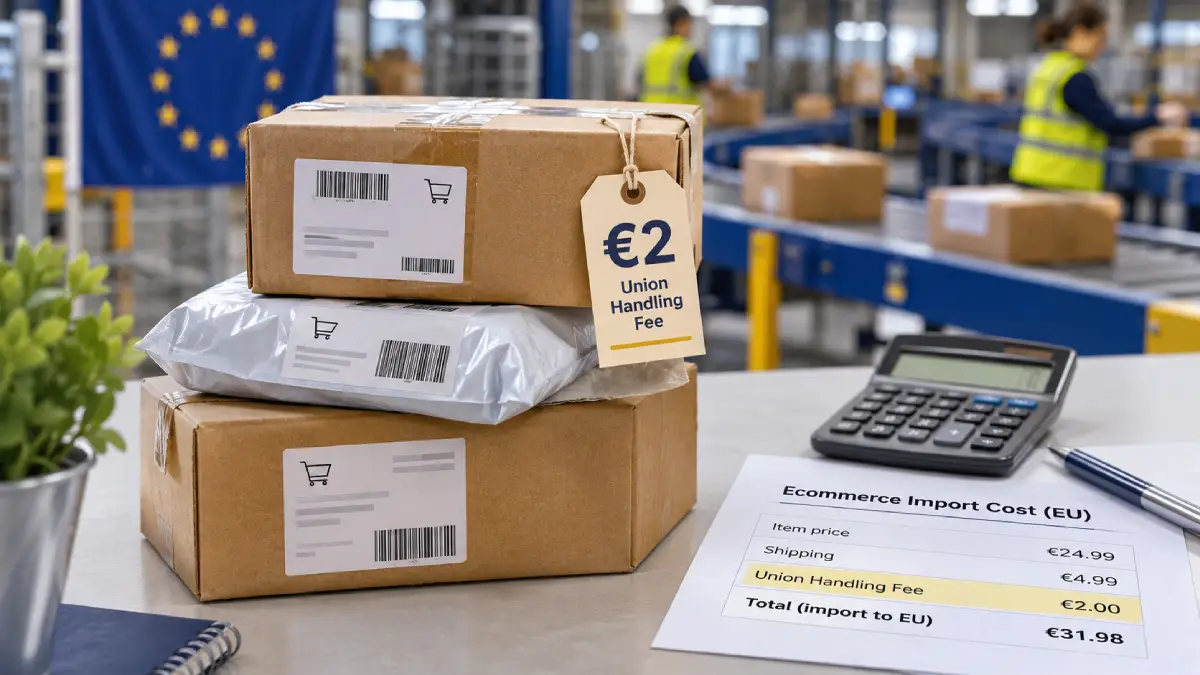
The EU’s new €2 Union Handling Fee is now in effect, and it matters to dropshippers shipping orders into Europe from outside the EU. The charge applies per distinct item in an ecommerce package, regardless of value, and sits on top of other import charges that may already apply.
The fee took effect on 1 November 2026 as part of the EU’s customs reform.
For small sellers, the big issue is simple: if you ship products from China, the UK, or another non-EU country to customers in EU member states, your landed costs may now be higher than they were a few weeks ago.
That does not automatically mean every seller will pay the charge directly. But it does mean dropshippers need to understand how it works, who may pass it on, and what it could do to margins.
What changed?
The new charge is called the Union Handling Fee, or UHF.
According to Irish Revenue’s guidance on the measure, the fee is €2 per distinct item for online purchases arriving from outside the EU, and it applies regardless of the value of the purchase. Revenue also explains that it is separate from, and in addition to, the €3 customs duty per item that has applied since 1 July 2026 on relevant low-value ecommerce imports. The European Commission’s customs reform materials list the Union handling fee as part of the current reform package.
A few details matter here:
- the fee applies to ecommerce distance sales
- it applies to B2C packages, not B2B shipments
- it applies per distinct item
- it is not refundable
- it can apply even when goods are later returned or found faulty
That “per distinct item” point is especially important.
If a package contains three different products, the charge can be applied three times. If it contains multiple units of the same item, the treatment may differ depending on how the declaration is structured. Revenue’s examples show how quickly the charges can add up on multi-item orders.
Who actually pays it?
Officially, the fee is paid by the seller or the business filing the customs declaration, such as the delivery company. In practice, that does not mean the cost stops there.
Revenue explicitly says the charge may be passed on to the end consumer.
That creates three possible outcomes for dropshippers:
- You absorb the cost and accept lower margins.
- Your shipping or sourcing partner passes it to you, which raises your fulfillment cost.
- The customer pays it, either at checkout or on delivery.
For a store owner, the real issue is not who pays first. It is whether your pricing and customer communication reflect the total cost accurately enough to avoid margin surprises or unhappy buyers.
Why this matters for dropshippers
This matters most for dropshippers selling low-cost or mid-ticket products into the EU from outside the bloc.
If you sell inexpensive products with tight margins, even a small extra import charge can have an outsized effect. A product that looked profitable before may no longer look quite so attractive once you account for:
- the €2 Union Handling Fee
- the existing €3 customs duty where relevant
- VAT
- any carrier administration charges
- refunds or failed deliveries
I think the biggest risk is not the headline fee itself. It is sellers continuing to price products as if nothing has changed.
That is especially dangerous if you use overseas suppliers and rely on older cost assumptions inside your product pricing, ad testing, or shipping rules.
There is also a customer experience issue.
Revenue says some websites collect the customs duty and the UHF at checkout, while others do not. If charges are not collected upfront, the delivery company may ask the customer to pay them before delivery.
That creates a predictable problem for ecommerce sellers: a customer who thought they had already paid the full amount may suddenly face extra charges at the delivery stage.
For a dropshipper, that can lead to:
- more support tickets
- more refused deliveries
- more refund disputes
- lower conversion rates if buyers know extra fees are likely
Which sellers are most exposed?
In my view, the sellers most exposed are:
- dropshippers shipping direct from China to EU customers
- UK sellers serving EU customers from Great Britain
- stores selling multi-item baskets
- sellers of low-priced products with slim margins
- sellers who do not clearly communicate duties and delivery charges
By contrast, sellers using EU-based warehouses may be less affected for those EU orders, because the charge applies to ecommerce goods arriving from outside the EU.
That does not make the problem disappear entirely, because not every supplier stocks every item locally. But it does strengthen the case for checking whether your best-selling products can be fulfilled from within the EU.
What should dropshippers do now?
I recommend doing four things.
1. Check where your products are actually shipping from
Do not assume the supplier’s website presentation tells the full story. A store may look European while the goods are still being dispatched from outside the EU. Revenue specifically warns consumers about that point, and the same logic applies to merchants evaluating suppliers.
2. Rework your landed-cost calculations
If you sell into the EU, revisit the actual economics of your products. For lower-priced goods, the combined effect of customs duty, the UHF, VAT, and courier handling can materially change profitability.
3. Review how charges are collected
Ask your supplier, agent, or shipping provider:
- is the €2 fee already included?
- is it collected at checkout?
- is it collected on delivery?
- who handles the customs declaration?
- what happens on returns or refused deliveries?
4. Consider whether EU fulfillment is now more attractive
This does not mean every dropshipper should rush into warehousing. But if you are serious about the EU market, I think this is another reason to compare direct-from-China fulfillment against EU-based stock for your best sellers.
Bottom line
The EU’s new €2 Union Handling Fee is not just another technical customs change.
It is a live cost increase on ecommerce goods shipped from outside the EU, and it could affect pricing, margins, and customer experience for dropshippers selling into Europe.
Some sellers will absorb it. Some will pass it on. Some customers will see it at checkout, while others may only discover it at delivery.
My advice is simple: check your shipping origin, recalculate your costs, and make sure you understand who is collecting what before this turns into a margin or customer-service problem.
Sources and further reading
- Irish Revenue — Revenue advises online shoppers of the introduction by the European Union (EU) of a new Union Handling Fee for goods bought from outside the EU: https://www.revenue.ie/en/corporate/press-office/press-releases/2026/pr-092926-handling-fee.aspx
- Irish Revenue — Union Handling Fee (UHF) – 1 November 2026: https://www.revenue.ie/en/customs/individuals/union-handling-fee/index.aspx
- Irish Revenue — How the fee applies: https://www.revenue.ie/en/customs/individuals/union-handling-fee/how-the-fee-applies.aspx
- Irish Revenue — What does this mean for consumers?: https://www.revenue.ie/en/customs/individuals/union-handling-fee/what-does-this-mean.aspx
- European Commission — EU Customs Reform: https://taxation-customs.ec.europa.eu/customs/eu-customs-reform_en