
What Online Delivery Statistics Mean for Dropshipping Sellers
Delivery is one of the few parts of a dropshipping order that the seller cannot carry out personally. The supplier prepares and ships the product, but the customer sees the delivery estimate on the seller’s website and contacts that seller if the parcel is late.
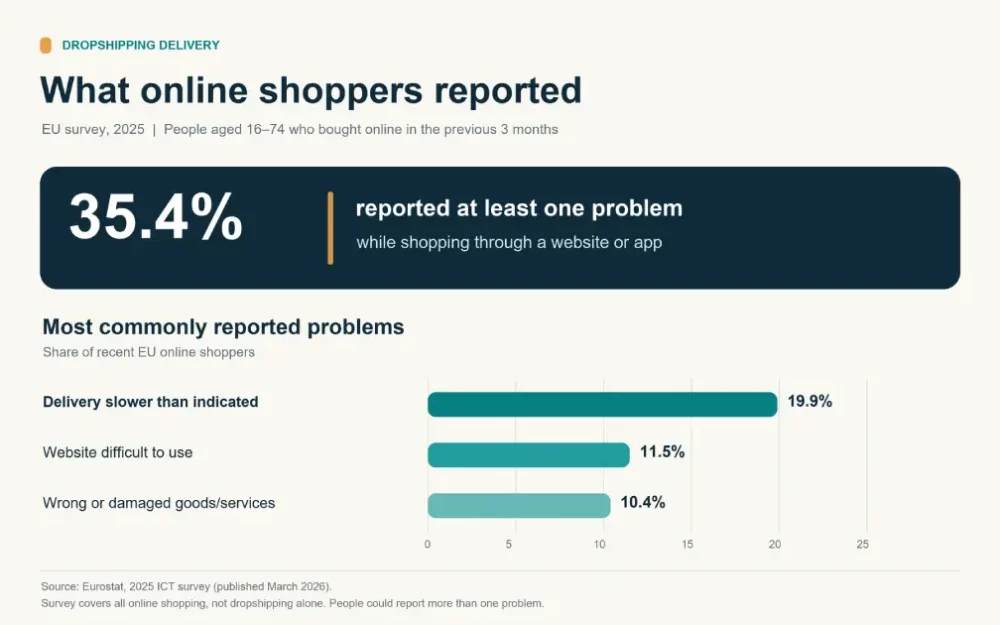
That makes delivery promises worth checking carefully. In a 2025 Eurostat survey, 19.9% of recent online shoppers in the EU reported delivery that was slower than indicated. It was the most commonly reported shopping problem. The survey covered online shopping generally, not dropshipping orders specifically, but it shows why a clear estimate matters to anyone selling products online.
What did shoppers report?
Eurostat asked people aged 16 to 74 who had bought something online in the three months before the survey about problems they encountered. 35.4% reported at least one problem when buying through a website or app.
| Problem reported by EU online shoppers | Share |
|---|---|
| Delivery slower than indicated | 19.9% |
| Website difficult to use or working poorly | 11.5% |
| Incorrect or damaged goods or services delivered | 10.4% |
Source: Eurostat’s 2025 survey results. Respondents could report more than one problem, so the percentages should not be added together.
The distinction between “slow” and “slower than indicated” is useful. A customer may accept a longer wait if the product page gives them an honest estimate before they pay. A shorter promise that the supplier cannot meet creates a different experience: the order appears late even if its journey is typical for that supplier.
The survey does not tell us how many dropshipping orders arrive late. It also does not show whether delays were caused by a retailer, supplier, carrier or another part of the journey. Its value for a dropshipping seller is to identify a common customer concern and test whether the store’s own promises account for it.
A delivery estimate has more than one part
A supplier’s advertised shipping time may begin after the order has been processed. If a supplier takes several days to prepare an item, showing only the carrier’s transit estimate on a product page understates the likely wait.
Suppose a supplier says it normally takes two to four business days to process an order and five to nine business days for shipping. A basic combined estimate is seven to thirteen business days from order to delivery. These figures are hypothetical; they illustrate why the two stages must be checked separately. A seller would still need to establish whether the supplier’s estimates are reliable for the destination and product in question.
The dispatch location matters too. A supplier may have warehouses in several countries without stocking every product in each one. “Ships from Europe” is useful only if that particular item will actually leave from a European warehouse for the customer’s order. Check the product-level shipping information and what happens when local stock runs out.
Before using a delivery estimate, ask the supplier when its clock starts, whether it counts business or calendar days, and whether processing time changes during busy periods. Check which destinations it serves, which shipping methods are available and whether tracking starts at dispatch or only after a carrier scan. A test order can reveal how the process works in practice, although one order cannot establish an average delivery time.
The promise should survive a stock problem
Dropshipping stores can display products without holding them. That flexibility also means the seller may learn about a stock shortage only after a customer orders, unless the supplier provides dependable inventory updates.
A delivery estimate should therefore reflect how the supplier handles unavailable items. Does it stop accepting orders, offer an alternative warehouse, or wait for a restock? How quickly does it tell the seller? These questions matter because a parcel cannot meet a delivery promise if the product is still waiting to be sourced.
For products with different suppliers or dispatch locations, a single sitewide delivery claim may be too broad. A product-specific estimate, or a clearly explained range by destination, gives customers more useful information. Where the seller cannot confirm a precise arrival date, a range is more honest than a date chosen for its marketing appeal.
Late parcels are only part of the risk
Eurostat found that 10.4% of recent EU online shoppers reported receiving incorrect or damaged goods or services. That figure covers all the types of online purchases in its survey. It is not a damage rate for parcels or for dropshipping suppliers.
For a seller, it points to another question to settle before listing a product: what happens when the supplier sends the wrong item or it arrives damaged? Find out who pays for a replacement, what evidence the supplier requires, how quickly it responds and where a return would go. The customer will need an answer from the store, regardless of which business packed the order.
Communication matters once something goes wrong. In Eurostat’s fuller account of the survey, 6% of online shoppers reported difficulty with complaints or redress, or an unsatisfactory response after complaining. A seller can prepare for that by knowing how to reach the supplier, keeping tracking and order details accessible, and giving customers a clear way to report a problem.
What should a dropshipping seller check first?
Start with one product and one delivery destination. Record the supplier’s stated processing time, transit time, dispatch location, tracking method and policy for stock shortages. Add the time periods together, then compare the result with the wording shown on the product page and at checkout. If the store promises faster delivery than the supplier’s own information supports, revise the promise before taking orders.
Repeat that check for products supplied from different warehouses and revisit it when a supplier changes shipping methods. Keep a record of actual orders as the store grows: order date, dispatch date, delivery date, destination and any reported problem. Your own results can eventually show whether a supplier meets the estimate you publish.
Eurostat’s survey describes the wider online shopping market. It cannot supply a delivery benchmark for a particular dropshipping store. It does give sellers a reason to examine a promise customers can see and remember: when will my order arrive?