
Zendrop Adds AI Agent for ChatGPT and Claude
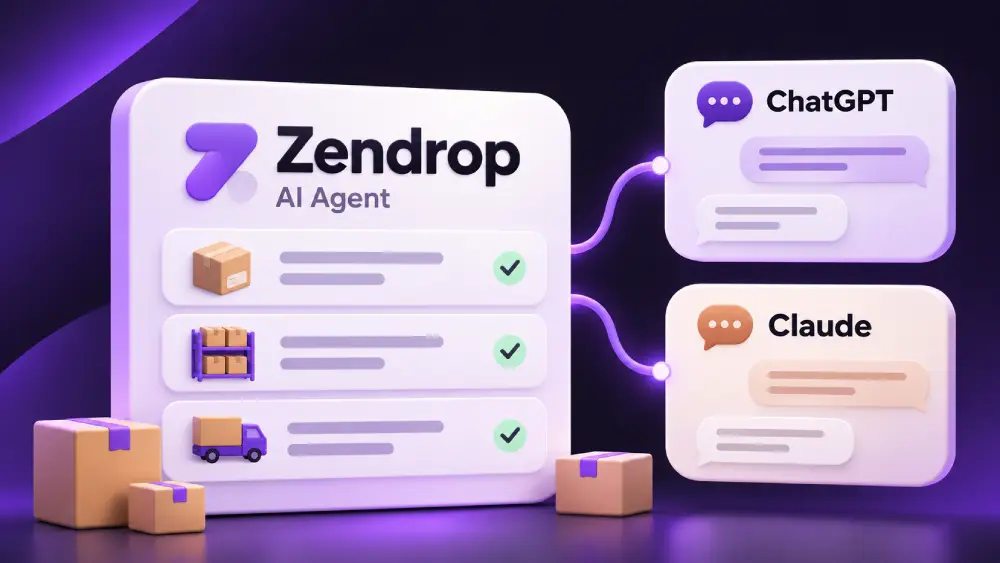
Zendrop has added a new AI Agent that lets sellers connect their accounts to ChatGPT or Claude and ask store-related questions in plain language.** For dropshippers, the feature could make routine order and sourcing checks faster, although it is still in beta and should be treated as a convenience tool rather than a replacement for proper oversight.
Zendrop announced the update on 17 November 2026 as part of a broader round of product changes.
The AI Agent is the headline feature, but the same announcement also includes free weekday onboarding calls for all users, a dedicated Order Issues page, separate payment cards for each store, and team-access tools for high-volume sellers.
For Dropship News readers, the main question is straightforward: does this save real time, or is it just another AI feature looking for a use case?
What changed?
According to Zendrop’s official announcement, the company is now listed in the ChatGPT and Claude app directories. A seller can connect a Zendrop account once, then ask questions about the store through a connected AI assistant.
Zendrop says sellers can ask things like:
- where a specific order is
- what an order cost
- what they spent on products and shipping last week
- whether an item is in stock
- which supplier is attached to a product
- where a product ships from
Zendrop’s help documentation also says its MCP connection allows ChatGPT, Claude, or another AI assistant to work with the store to find products, check orders, estimate shipping, and even fulfill an order with confirmation from the seller.
That last point matters.
This is not just a chatbot sitting next to the dashboard. Zendrop is positioning it as a practical layer on top of store operations.
How the AI Agent works
Zendrop describes the system as a secure connection between your AI assistant and your Zendrop account.
To use it, the seller needs to:
- connect the account
- approve access
- ask questions in ChatGPT, Claude, or through Zendrop’s own interface
Zendrop says the agent can answer account-specific questions from the connected store, and that it can also handle scheduled tasks such as a regular check for unfulfilled orders.
The company’s help center also notes two useful safeguards:
- access has to be approved
- fulfillment actions pause for confirmation before shipping
That makes the feature more practical than a pure AI demo, but it also underlines that sellers still need to supervise what the system is doing.
Zendrop’s own help content says the AI assistant is currently in beta.
Why this could be useful for dropshippers
I think the strongest case for the AI Agent is not “AI automation” in the abstract. It is reducing dashboard friction.
A lot of day-to-day dropshipping work is made up of small checks:
- Has this order shipped yet?
- Which products are unfulfilled?
- What did I spend last week?
- Which store is using which card?
- Is this item still in stock?
- Can I estimate shipping before listing a product?
Those are not difficult tasks, but they do involve a lot of clicking around.
If Zendrop’s AI Agent reliably answers those questions inside tools sellers already use, that could be genuinely helpful.
The feature may be most useful for:
- sellers managing multiple stores
- merchants handling higher order volume
- users who already rely on ChatGPT or Claude during the workday
- beginners who want simpler access to store information without learning every corner of the platform first
Zendrop’s broader November update supports that interpretation.
The company also introduced:
- free weekday onboarding calls for all plans
- Zendrop Academy 2.0 inside the platform for paid plans
- a dedicated Order Issues page for all plans
- separate default payment cards per store
- team logins for high-volume sellers
Taken together, this looks less like a single AI announcement and more like an attempt to make Zendrop easier to operate as sellers grow.
What this does not mean
This is where I would be careful.
The AI Agent does not remove the normal risks of running a dropshipping business.
It does not guarantee:
- better suppliers
- faster shipping
- fewer fulfillment mistakes
- higher conversion rates
- more profitable products
And because the feature is still in beta, it would be a mistake to assume every answer will always be perfectly reliable.
I also would not treat it as an excuse to stop checking important order or fulfillment details manually, especially if you are handling customer complaints, stock issues, or time-sensitive shipping decisions.
Convenience is useful. Blind trust is not.
What about the other updates?
The AI Agent is the strongest story, but a few of the other changes deserve attention.
Order Issues gets its own page
Zendrop says all plans now have a dedicated Order Issues page, with filtering and tracking details. I think this is actually one of the more practical improvements in the whole update, especially for sellers dealing with multiple support cases.
Separate payment cards for each store
For multi-store sellers, this is a sensible operational feature. Zendrop says users can now set a default payment card for each connected store and export statements by store or across stores.
Team access for high-volume sellers
Zendrop’s help documentation explains that invited team members can manage orders, products, inventory, and fulfillment, while billing and user management remain with the owner. That is useful for stores that have outgrown the “one person does everything” stage.
What should sellers do now?
I recommend three things.
1. Test the AI Agent on low-risk tasks first
Use it for information retrieval before you rely on it for anything more sensitive. Ask about inventory, order status, and spending. Make sure the answers match what you see in the dashboard.
2. Keep a human check on fulfillment actions
Zendrop says fulfillment pauses for confirmation, which is good. I would keep it that way and avoid treating the tool as full autopilot.
3. Look at the operational updates, not just the AI headline
For some sellers, the biggest immediate value may come from the Order Issues page, separate payment cards, or team access rather than the AI connection itself.
Bottom line
Zendrop’s new AI Agent is one of the more practical AI updates I’ve seen from a dropshipping platform recently.
If it works as advertised, it could save sellers time by turning routine Zendrop checks into simple chat-based questions inside ChatGPT or Claude. That is a real convenience win.
But it is still a beta feature, and I think it should be treated like an assistant, not a decision-maker.
My advice is to test it carefully, use it to reduce repetitive admin work, and judge it on whether it genuinely saves time inside your store workflow.
If it does, this is a meaningful platform improvement. If it doesn’t, it will be remembered as another AI feature that sounded better than it worked.
Sources and further reading
- Zendrop — What’s New in Zendrop: 7 Exciting Updates for Fall 2026: https://www.zendrop.com/blog/feature-updates-fall-2026/
- Zendrop Help Center — Connect Zendrop MCP to your AI assistant: https://support.zendrop.com/en/articles/15349416-connect-zendrop-mcp-to-your-ai-assistant
- Zendrop Help Center — How to Use the Zendrop AI Assistant: https://support.zendrop.com/en/articles/17272521-how-to-use-the-zendrop-ai-assistant
- Zendrop Help Center — How to Add Team Members and Share Store Access in Zendrop: https://support.zendrop.com/en/articles/16736802-how-to-add-team-members-and-share-store-access-in-zendrop
- Zendrop Help Center — How to Add a Payment Method on Zendrop: https://support.zendrop.com/en/articles/9437726-how-to-add-a-payment-method-on-zendrop